Authentic Pathrode Recipe (Mangalorean Steamed Colocasia Leaf Rolls)
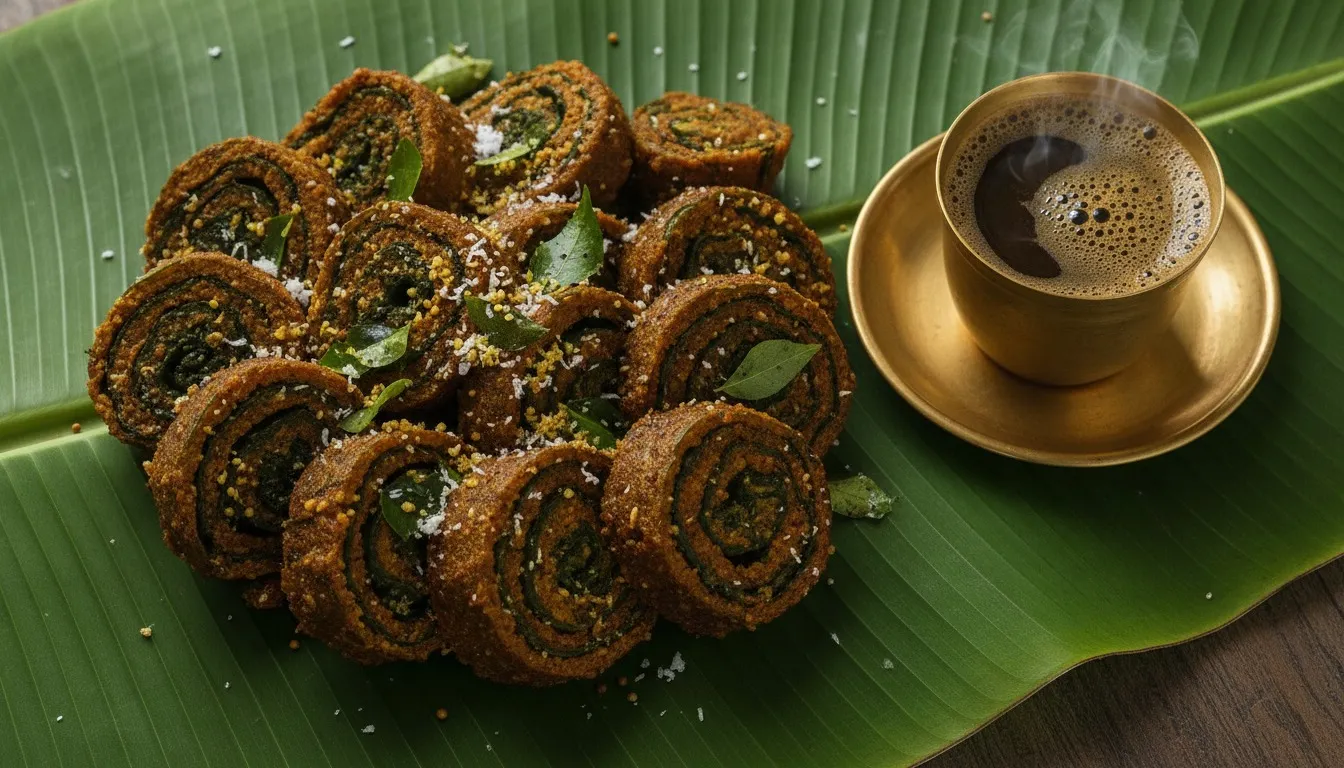
Pathrode is one of those dishes that arrives with the rain. When the monsoon breaks along the Karnataka coast, colocasia leaves push up thick and glossy in every backyard, and kitchens from Mangalore to Udupi start grinding rice and coconut to use them up. The dish has been having a real moment online lately, showing up in roundups of regional monsoon snacks worth trying beyond the usual pakoras, and it deserves the attention. Layers of leaf and spiced rice paste steam together into something that slices like a savoury roll cake, green spirals running through a rust-coloured batter. Warm from the steamer with a mustard seed tempering over the top, it is unlike anything else in the South Indian snack repertoire.
About This Dish
The dish belongs to Tulunadu, the coastal strip covering Dakshina Kannada and Udupi, and is claimed with equal affection by Konkani, Bunt and Mangalorean Catholic households. It goes by pathrode, pathrade, patrode and kesuvina ele pathrode depending on who is cooking, and it has close cousins further up the coast in Gujarat’s patra and Maharashtra’s alu vadi. What sets the coastal Karnataka version apart is the base: soaked raw rice ground with fresh coconut, tamarind and dried red chillies rather than a gram flour batter. It was originally food of thrift, a way to turn a plant that grows wild and free into a filling meal, and it is still cooked most often in the weeks when the leaves are at their best.
Ingredient Notes
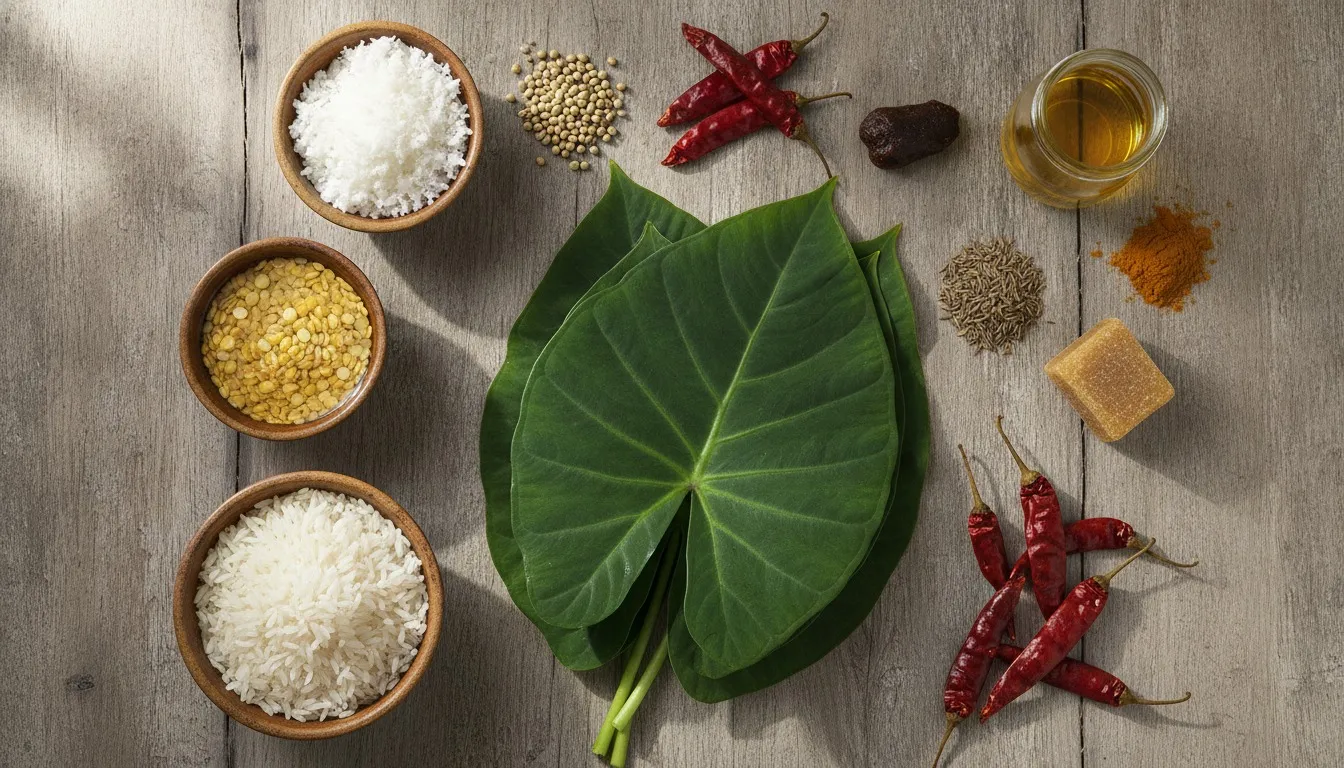
The leaves matter more than anything else here. Colocasia leaves, sold as taro or arbi leaves at most Indian and many Asian grocers, contain calcium oxalate crystals that cause an itchy, scratchy throat if handled carelessly. Two things neutralize them: shaving away the thick central rib and veins from the back of each leaf, and grinding enough tamarind into the paste. Mature leaves with thin veins and a maroon-tinged stem behave far better than young, tender ones. For the paste, any short or medium grain raw rice works, with sona masoori and idli rice both reliable, and a small handful of moong dal added for body. Fresh grated coconut is best, though frozen grated coconut thawed to room temperature is a fair substitute, and byadgi or kashmiri chillies give the colour without excessive heat.
Method And Tips
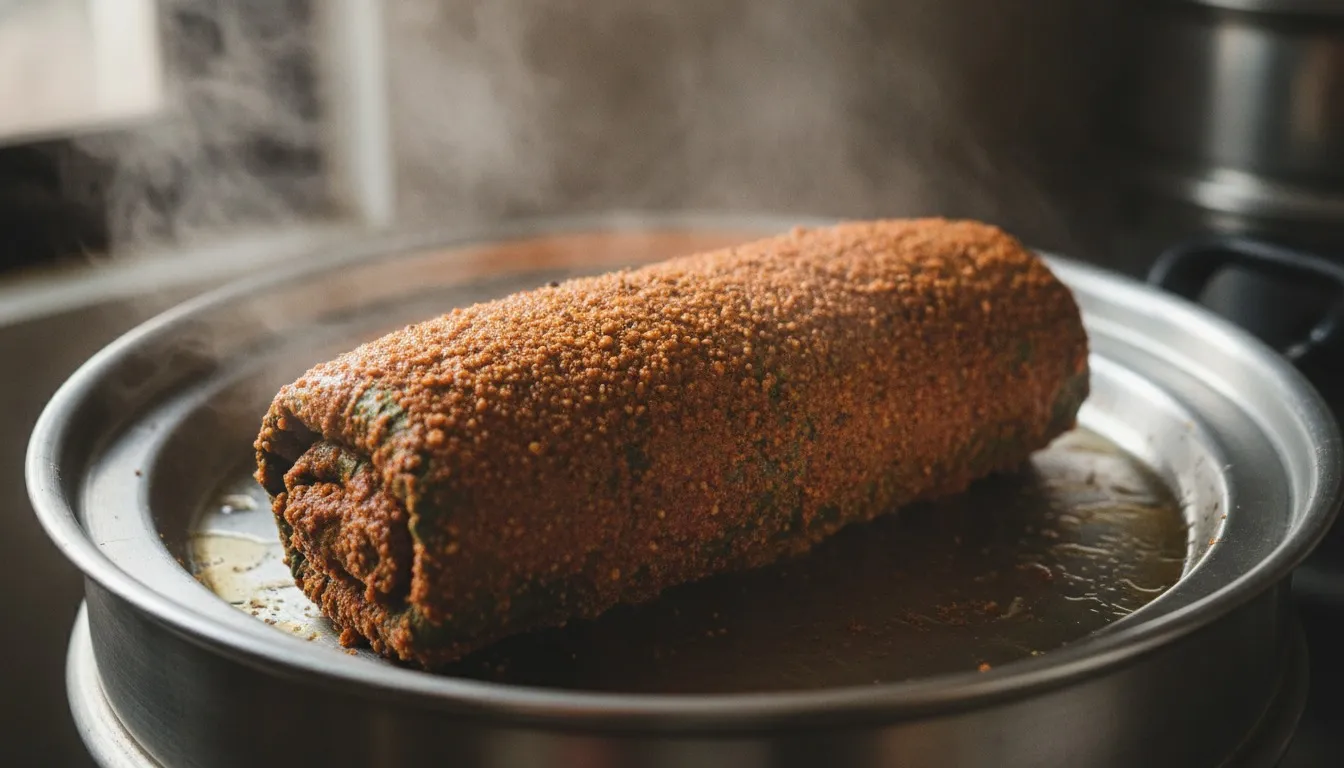
Consistency is the technique that decides whether this works. The ground paste should be thick enough to sit on the back of a spoon without sliding, roughly like idli batter, because anything looser runs straight off the leaf and pools in the steamer. Grind with as little water as the mixie will tolerate and add more only a spoonful at a time. Roll the logs tightly, since a loose roll steams into loose slices that fall apart on the plate. The second tip is patience at the end: let the logs rest in the switched-off steamer for ten minutes and cool for another fifteen before cutting, because hot pathrode crumbles no matter how well it was rolled. A knife pushed into the centre coming out clean is the only doneness test worth trusting.
Serving Suggestions
Serve pathrode hot with strong filter coffee or tea on a wet afternoon, or alongside a plain dal and rice as part of a coastal meal. Any slices that survive to the next day are best shallow fried in coconut oil until the edges crisp, which many families consider the better version anyway. If a bundle of taro leaves ever catches your eye at the grocer, buy them and make this once. It is worth the afternoon.
Recipe
Pathrode
Colocasia leaves layered with a ground paste of soaked rice, coconut, tamarind and dried red chillies, rolled into logs and steamed until set. A coastal Karnataka and Konkani monsoon specialty served sliced and tempered.
- Prep
- 30min
- Cook
- 35min
- Total
- 65min
- Servings
- 6servings
- Calories
- 310kcal
Ingredients
- For the masala paste
- 1.5 cups raw rice, such as sona masoori or idli rice
- 1/4 cup split yellow moong dal
- 1 cup grated coconut, fresh or frozen and thawed
- 8 dried red chillies, byadgi or kashmiri
- 1 tbsp coriander seeds
- 2 tsp cumin seeds
- 1/2 tsp turmeric powder
- 2 tbsp seedless tamarind, firmly packed
- 2 tbsp jaggery, grated
- 1.5 tsp salt
- For the rolls
- 12 colocasia leaves, also sold as taro or arbi leaves, medium to large
- For the tempering
- 2 tbsp coconut oil
- 1 tsp mustard seeds
- 1 tsp urad dal
- 10 curry leaves
- 1/4 cup grated coconut
Instructions
- 1 Rinse the rice and moong dal together in two or three changes of water, then cover with fresh water and soak for 4 hours. Drain well before grinding.
- 2 While the rice soaks, soak the tamarind in 1/4 cup hot water for 20 minutes so it softens and grinds smoothly.
- 3 Wipe each colocasia leaf clean with a damp cloth and pat dry. Snap off the stalk, then lay each leaf face down and shave off the raised central rib and the thickest veins with a small sharp knife. This is what keeps the finished pathrode from scratching the throat, so do not skip it.
- 4 Grind the drained rice and dal with the coconut, dried red chillies, coriander seeds, cumin seeds, turmeric, soaked tamarind with its water, jaggery and salt. Add water a few tablespoons at a time and grind to a thick, smooth paste roughly the consistency of idli batter that holds its shape on a spoon. A loose paste will run off the leaves.
- 5 Taste the paste. It should read clearly sour and salty with a mild sweetness behind it. If it tastes flat, grind in a little more tamarind, since the acidity is what neutralizes the leaves.
- 6 Place the largest leaf face down on a work surface with the tip pointing away from you. Spread a thin, even layer of paste over the whole leaf using the back of a spoon or your fingers.
- 7 Lay a second leaf on top, face down and slightly smaller, and spread paste over it. Repeat until you have stacked 4 leaves, finishing with a layer of paste on top.
- 8 Fold both long sides of the stack in toward the centre, spread a little paste over the folded edges to seal them, then roll the stack up tightly from the base to the tip into a firm log. Set it seam side down. Repeat with the remaining leaves to make 3 logs.
- 9 Bring water to a boil in a steamer or idli pot. Arrange the logs on a greased plate or in the steamer basket, leaving space between them, and steam covered for 30 to 35 minutes. The pathrode is done when a knife pushed into the centre comes out clean with no wet batter clinging to it.
- 10 Let the logs rest in the switched-off steamer for 10 minutes, then cool for another 15 minutes before slicing. Cutting them hot makes the slices crumble. Slice into rounds about 1/2 inch thick.
- 11 Heat the coconut oil in a wide pan over medium heat. Add the mustard seeds and let them pop, then add the urad dal and fry until golden. Add the curry leaves and grated coconut and stir for 30 seconds.
- 12 Slide the pathrode slices into the pan, toss gently to coat them in the tempering, and warm through for 2 to 3 minutes. Serve hot.
Notes
- Soaking time is not counted in the times above. Plan for 4 hours of soaking, or soak the rice and dal overnight in the refrigerator.
- Choose mature, deep green leaves with a maroon-tinged stem and thin veins on the underside. Very young leaves and leaves with thick, fibrous veins are the usual cause of an itchy throat.
- If the leaves are very large, use 3 per log instead of 4 and make an extra log. If they are small, stack 5 or 6.
- Leftover slices are excellent shallow fried in coconut oil until crisp on both sides, which is how pathrode is usually eaten the next day.
- Steamed logs keep in the refrigerator for up to 4 days and freeze well for a month. Steam or pan fry straight from cold to reheat.